USA v. Delaney Equity Group LLC

I just saw that Delaney Equity Group LLC (a small broker and OTC market maker) has been criminally charged in an ongoing ‘shell factory’ investigation. See the Palm Beach Post story. Below I have downloaded the court docket and linked all the documents currently available. I intend to post updates to this occasionally (at least for important filings). Read the complaint. The SEC had filed civil charges against Delaney back in 2015.

Excerpt from the complaint:

7. DELANEY EQUITY GROUP LLC, lndividual A, and Ian C. Kass would prepare Forms 211 on behalf of the issuers and submit them to the Financial Industry Regulatory Authority (“FINRA”) so that shares of the issuers could be quoted and traded over-the-counter. These forms falsely and fraudulently represented that the companies were executing their business plans and were operating under the direction of the straw CEO.

The allegations go on, but the fact that the forms 211 are mentioned is a big deal for OTC Markets in my opinion– this could scare off market makers from filing these forms for any sketchy company in the future.

U.S. District Court
Southern District of Florida (Miami)
CRIMINAL DOCKET FOR CASE #: 1:18-cr-20336-CMA All Defendants

Case title: USA v. Delaney Equity Group LLC Date Filed: 04/26/2018

Assigned to: Judge Cecilia M. Altonaga
Defendant (1)
Delaney Equity Group LLC represented by Ryan Dwight O’Quinn 
DLA Piper LLP (US)
200 South Biscayne Boulevard
Suite 2500
Miami, FL 33131
305-423-8553
Fax: 305-675-0807
Email: ryan.oquinn@dlapiper.com
LEAD ATTORNEY
ATTORNEY TO BE NOTICEDElan Abraham Gershoni 
DLA Piper LLP (US)
200 S. Biscayne Boulevard
Suite 2500
Miami, FL 33131
305.423.8500
Fax: 305.675.0527
Email: Elan.Gershoni@dlapiper.com
ATTORNEY TO BE NOTICED
Pending Counts Disposition
18:371.F CONSPIRACY TO UNLAWFULLY SELL UNREGISTERED SECURITIES
(1)
Highest Offense Level (Opening)
Felony
Terminated Counts Disposition
None
Highest Offense Level (Terminated)
None
Complaints Disposition
None

Plaintiff
USA represented by Jerrob Duffy 
United States Attorney’s Office
99 N.E. Fourth Street
4th Floor
Miami, FL 33132
305-961-9273
Fax: 305-536-5321
Email: jerrob.duffy@usdoj.gov
LEAD ATTORNEY
ATTORNEY TO BE NOTICED
Designation: Retained


Date Filed # Docket Text
04/26/2018 1 INFORMATION as to Delaney Equity Group LLC (1) count 1 and FORFEITURE COUNT. (wc) (Entered: 04/26/2018)
04/26/2018 2 NOTICE of Similar Action by USA as to Delaney Equity Group LLC (Duffy, Jerrob) (Entered: 04/26/2018)
04/26/2018 3 NOTICE OF ATTORNEY APPEARANCE: Ryan Dwight O’Quinn appearing for Delaney Equity Group LLC . Attorney Ryan Dwight O’Quinn added to party Delaney Equity Group LLC(pty:dft). (O’Quinn, Ryan) (Entered: 04/26/2018)
04/26/2018 4 NOTICE OF ATTORNEY APPEARANCE: Elan Abraham Gershoni appearing for Delaney Equity Group LLC . Attorney Elan Abraham Gershoni added to party Delaney Equity Group LLC(pty:dft). (Gershoni, Elan) (Entered: 04/26/2018)
05/09/2018 5 PAPERLESS NOTICE OF HEARING as to Delaney Equity Group LLC: Change of Plea Hearing set for 5/21/2018 08:30 AM in Miami Division before Judge Cecilia M. Altonaga. (ps1) (Entered: 05/09/2018)
05/09/2018 6 PAPERLESS NOTICE OF HEARING as to Delaney Equity Group LLC: Initial Appearance and Arraignment set for 5/21/2018 08:30 AM in Miami Division before Judge Cecilia M. Altonaga. (ps1) (Entered: 05/09/2018)
05/21/2018 7 WAIVER OF INDICTMENT by Delaney Equity Group LLC (ps1) (Entered: 05/21/2018)
05/21/2018 8 PAPERLESS Minute Entry for proceedings held before Judge Cecilia M. Altonaga: Initial Appearance and ARRAIGNMENT as to Delaney Equity Group LLC (1) Count 1 held on 5/21/2018. Date of Arrest or Surrender: 5/21/18. Total time in court: 1 minutes. Attorney Appearance(s): Jerrob Duffy, Ryan Dwight O’Quinn, Elan Abraham Gershoni, Court Reporter: Stephanie McCarn, 305-523-5518 / Stephanie_McCarn@flsd.uscourts.gov. (ps1) (Entered: 05/21/2018)
05/21/2018 9 PAPERLESS Minute Entry for proceedings held before Judge Cecilia M. Altonaga: Change of Plea Hearing held on 5/21/2018. Delaney Equity Group LLC (1) Guilty Count 1. Total time in court: 25 minutes. Attorney Appearance(s): Jerrob Duffy, Ryan Dwight O’Quinn, Elan Abraham Gershoni, Court Reporter: Stephanie McCarn, 305-523-5518 / Stephanie_McCarn@flsd.uscourts.gov. (ps1) (Entered: 05/21/2018)
05/21/2018 10 PLEA AGREEMENT as to Delaney Equity Group LLC (ps1) (Entered: 05/21/2018)
05/21/2018 11 PAPERLESS NOTICE OF SENTENCING HEARING as to Delaney Equity Group LLC. Sentencing set for 7/26/2018 09:00 AM in Miami Division before Judge Cecilia M. Altonaga. If more than 30 minutes will be required, please contact the courtroom deputy to arrange. Defense counsel shall report immediately to the United States Probation Office for further instructions. (ps1) (Entered: 05/21/2018)
05/22/2018 12 Notice of Presentence Investigation Assignment of Delaney Equity Group LLC to US Probation Officer Vanessa Pulido in the Miami Wilkie D. Ferguson, Jr. U.S. Courthouse and she can be contacted at (305)523-5454 or Vanessa_Pulido@flsp.uscourts.gov. (lrn) (Entered: 05/22/2018)

Updated 6/27/2018.

See full docket at CourtListener.

Sentencing for Delaney Equity Group is set for 7/26/2018.

Excerpt from the plea agreement:

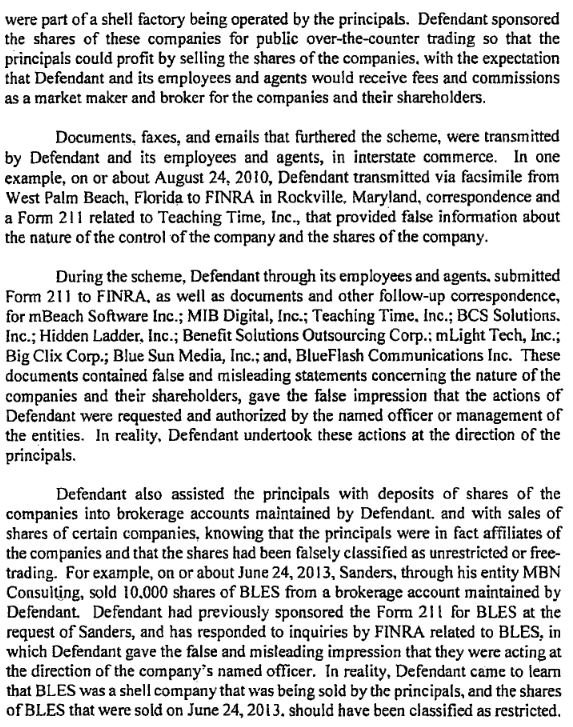
15. The Defendant hereby (i) confirms that it has reviewed the following facts with legal counsel, (ii) adopts the following factual summary as his own statement, (iii) agrees that the following facts are true and correct, and (iv) stipulates that the following facts provide a sufficient factual basis for the plea of guilty in this case, in accordance with Rule 11(b)(3) of the Federal Rules of Criminal Procedure:

Disclaimer. I have no position in any stock mentioned above. I have no relationship with any parties mentioned above. This blog has a terms of use that is incorporated by reference into this post; you can find all my disclaimers and disclosures there as well.
SEC fines Aegis Capital Corporation after it admits to failing to file SARs

On March 28, 2018 the SEC announced in a press release that Aegis Capital Corporation (a broker and investment bank) had settled with the SEC following accusations of failing to file suspicious activity reports (SARs) that brokers are required to file.

From the press release:

Broker-dealers are required to file SARs for certain transactions suspected to involve fraudulent activity or have no business or apparent lawful purpose.  The SEC’s order found that Aegis failed to file SARs on suspicious transactions that raised red flags indicating the transactions were potentially related to the market manipulation of low-priced securities.

“Aegis failed to meet its AML obligations to report suspicious activity, including when it was faced with specific information alerting the firm to suspicious transactions,” said Antonia Chion, Associate Director and head of the Broker-Dealer Task Force of the SEC’s Enforcement Division.  “Given the critical importance of SARs to the regulatory and law enforcement community, brokerage firms must comply with their SAR reporting obligations.”

The SEC’s order found that Aegis willfully violated an SEC financial recordkeeping and reporting rule.  Aegis agreed to pay a $750,000 penalty and retain a compliance expert.  FINRA also announced a settlement with Aegis today that includes an additional $550,000 penalty. 

In addition to the fines against the company, two Aegis employees settled with the SEC and agreed to fines and a third is defending himself against the SEC’s charges:

In a separate settled order, Aegis’ former anti-money laundering (AML) compliance officer Kevin McKenna was found to have aided and abetted the firm’s violations.  Aegis CEO Robert Eide was found to have caused them.  Without admitting or denying the SEC’s findings, Eide and McKenna agreed to pay penalties of $40,000 and $20,000, respectively.  McKenna also agreed to a prohibition from serving in a compliance or AML capacity in the securities industry with a right to reapply.     

In a litigated order, the Enforcement Division alleges that another former Aegis AML compliance officer, Eugene Terracciano, failed to file SARs on behalf of Aegis.  Terracciano is alleged to have aided and abetted and caused Aegis’ violations.  The matter pertaining to Terracciano will be scheduled for a public hearing before an administrative law judge, who will prepare an initial decision stating whether the Enforcement Division has proven the allegations in the order and what, if any, remedial actions are appropriate. 


SEC Press Release
FINRA Press Release
SEC Order on Aegis Capital (PDF)
SEC Order on Kevin McKenna and Robert Eide (PDF)
SEC Order on Eugene Terracciano (PDF)


The SEC orders have lots of great details, some of which I have excerpted below. While firms and clients and stocks are not named, I was able to determine two of the stocks given as examples in the orders (Issuers A and F).

First, some details about Aegis’ business from the SEC order on Aegis (emphasis mine):

RESPONDENT
Aegis is a dually-registered investment adviser and broker-dealer with multiple branches and is headquartered in New York, NY. For its fiscal year 2014, Aegis had revenues of approximately $123 million and, for its fiscal year 2015, revenues of approximately $98 million. During those fiscal years, Aegis had revenues of approximately $250,000 and $270,000 from its low-priced securities business. Aegis’ business consists of investment banking, venture capital,
and debt market services as well as full-service retail and institutional advisory and brokerage services. Aegis’ CEO is also the firm’s founder and 100% owner.

FACTS
A. Aegis’ Low Priced Securities Business
1. During the relevant period, Aegis had various brokerage customers who transacted in low-priced securities. Several of these customers did so through DVP/RVP accounts. In
DVP/RVP accounts held at Aegis, the customer deposited their shares at another firm in a custodial account, and the sale transactions were effected through Aegis. During the
relevant period, Aegis had relationships with various clearing firms that assisted in effecting low-priced securities transactions.

2. Aegis had customers at their branch offices who transacted in low-priced securities.
Several of these customers were foreign financial institutions that effected transactions on
behalf of their underlying customers, all of whom were unknown to Aegis.

So Aegis penny stock business was very small relative to the size of its business overall and it appears that much of the low-priced securities (penny stock) business was with foreign financial firms. One such client (“customer A”) is described as well as its trading in “Issuer A” (quote from the Order on Aegis; emphasis mine):

Illustrative Examples of Transactions in which Aegis Failed to File SARs
i. Customer A
23. Between October 17 and December 27, 2012, an Aegis customer – Customer A – sold approximately 2.1 million shares of Issuer A, which traded on OTC Link (previously
“Pink Sheets”) operated by OTC Markets Group Inc. (“OTC Link”). Customer A held a DVP/RVP account at Aegis and is a private Swiss bank that traded significant volumes of low-priced securities through an omnibus arrangement with Aegis on behalf of the Swiss bank’s underlying clients who were unknown to Aegis.

24. At the same time Customer A was selling shares of Issuer A, a stock promotion touting the company’s prospects was underway. Coinciding with the promotional campaign,
Issuer A’s share price fluctuated from a low of $0.51 to a high of $0.93 on average daily volume of 558,792 shares. In the two months prior to October 17, 2012, no shares of
Issuer A traded at all. Thus, Customer A’s trading in Issuer A occurred during a period of a sudden spike in price and volume – which were specific AML red flags identified in
Aegis’ written supervisory procedures.

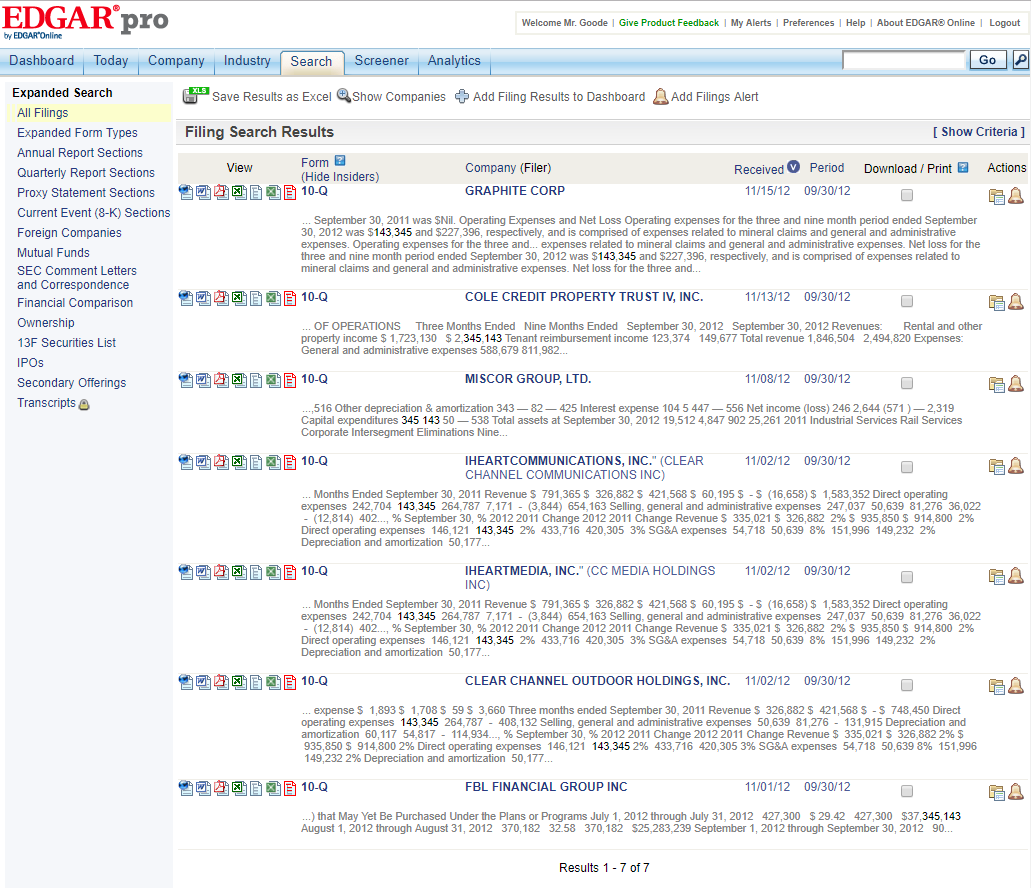
25. Prior to Customer A’s trading in Issuer A, Issuer A had undergone several name changes – again a specific AML red flag identified in Aegis’ written supervisory procedures. Moreover, contrary to the rosy picture of Issuer A painted by the above described promotional campaign, Issuer A’s Form 10-Q for the period ending September 30, 2012 reported that Issuer A had no revenues, a net loss of $143,345, and a “going concern” statement from its management.


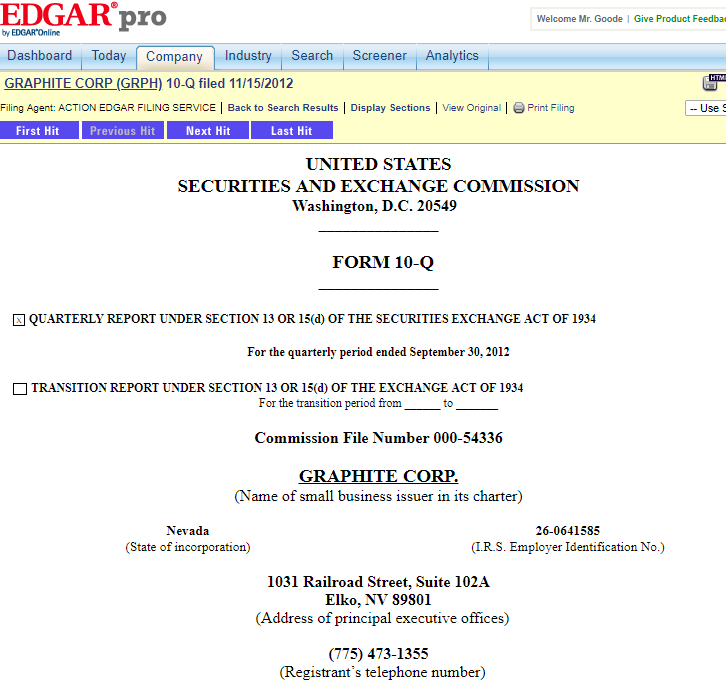
After doing a search on Edgar Pro I discovered that the only company with a net loss of $143,345 in that quarter was Graphite Corp (GRPH at the time) that was a pump and dump at the time (and multiple times since). Therefore Graphite Corp is Issuer A. Here is a screenshot of the results of my search:

And a screenshot of the 10-Q in question:


Another stock traded by Customer A was also a purported graphite company undergoing a pump and dump campaign (Issuer B). From the order on Aegis:

In addition to the suspicious trading noted above, there were other indicia that Issuer B likely was the subject of market manipulation. For example, Issuer B reported in 2013 that it was a world-class graphite company, yet two years earlier it had been a Malaysian publishing company that operated under a different name. Recent changes in an issuer’s name and business was one of the specific AML red flags identified in Aegis’ written supervisory procedures.

“Customer B” is also interesting:

37. Customer B is a British Virgin Islands company based in China that offers consulting and advisory services.
38. In an approximately one month period beginning in April 2013, Customer B sold approximately 200,000 shares of Issuer C through Aegis for proceeds of $2.3 million, or
over $10 per share. Issuer C was listed on NASDAQ.

“Customer D” was yet another foreign company:

55. Another Aegis customer – Customer D – engaged in suspicious low-priced securities transactions for which Aegis did not file a SAR. Customer D was a foreign financial
institution with a DVP/RVP account at the firm and traded on behalf of underlying customers who were unknown to Aegis.
56. Over an approximately six-month period beginning in late May 2013, Customer D sold approximately 457,000 shares of Issuer F for proceeds of approximately $2.8 million. Issuer F traded on OTC Link. Just prior to the trading – and coinciding with a promotional campaign – Issuer F’s share price climbed from $3.90 to $9.39 on
substantially increased volume.
57. Customer D was not the only Aegis customer who traded suspiciously in Issuer F. Starting approximately two months before Customer D’s trading, Customers A and E sold a substantial amount of Issuer F shares for substantial proceeds. Customer E was yet another foreign financial institution with a DVP/RVP account at the firm and traded on behalf of underlying customers who were unknown to Aegis; it was incorporated in New Zealand and operated from Switzerland

Based solely on the description of the stock price and volume, I believe that “Issuer F” is Octagon Resources (OCTX), about which I wrote a blog post. In addition to “Customer D” selling shares of “Issuer F”, “Customer A” and “Customer E” also sold many shares:

Starting approximately two months before Customer D’s trading, Customers A and E sold a substantial amount of Issuer F shares for substantial proceeds. Customer E was yet another foreign financial institution with a DVP/RVP  account at the firm and traded on behalf of underlying customers who were unknown to Aegis; it was incorporated in New Zealand and operated from Switzerland.
58. In particular, Customer A sold approximately 638,000 shares of Issuer F for proceeds of approximately $3.7 million while Customer E sold approximately 494,000 shares of Issuer F for proceeds of approximately $3.3 million. Thus, together Customers A and E sold over one million shares of Issuer F for proceeds of approximately $7 million.


I am late to reporting this and I apologize for that (I did previously tweet about it on the day it was announced).


Disclaimer. I have no position in any stock mentioned above. I have no relationship with any parties mentioned above. This blog has a terms of use that is incorporated by reference into this post; you can find all my disclaimers and disclosures there as well.
FINRA reaches decision against microcap broker Wilson-Davis & Co

While searching for another FINRA decision I came across an extended hearing panel decision from February 27, 2018 by FINRA that lays out in detail many things that some penny stock traders have guessed or suspected about broker and market maker Wilson-Davis Co and Anthony Kerrigone. That FINRA decision is against Wilson-Davis & Co, James C. Snow (President and Chief Compliance Officer), and Byron B. Barkley (Head of Trading). Do note that this decision has been appealed to the FINRA appeals panel. Until the appeal is resolved the suspensions will not take effect and the fines will not have to be paid. It is possible that the respondents will win the appeal and face lesser sanctions or no sanctions.

I previously wrote about Wilson-Davis and Kerrigone a little over a year ago when the SEC fined Wilson-Davis for Reg SHO violations.

The penalties are (all quotes in this post are from the decision):

Respondent Wilson-Davis & Co. is fined $1,170,000 and ordered to disgorge $51,624 for improper short sales. For its failure to supervise and implement adequate AML procedures, Wilson-Davis is fined an additional 300,000,
while Respondents James Snow and Byron Barkley are fined $140,000 and $115,000, respectively, and both are suspended for one year and ordered to requalify before re-entering the industry.

The really interesting things in the decision all concern Anthony Kerrigone:

Wilson-Davis hired registered representative Anthony Kerrigone (“Kerrigone”) as a trader in September of 2008. Although Kerrigone maintained a small number of retail customers, his primary business was trading in one of the Firm’s proprietary accounts as a market maker in various securities. Kerrigone’s “niche” as a market maker was the markets of penny stock companies that traded in high volume following promotional or touting campaigns. Kerrigone researched stocks to find those that were experiencing a run up in price because “they were being promoted and touted,” even though the securities were “generally worthless” and “had zippo, no value.” Because the promoters “managed to figure out how they’d get a lot of people to buy” these “worthless” stocks, they presented a “trading opportunity” for Kerrigone.

Once Kerrigone identified a suitable “trading opportunity,” his activity in the security followed a consistent pattern. Kerrigone entered the market of an actively promoted stock by first selling the security short, on the assumption that once the market impact of promotional activity dissipated the stock would lose value. Although Kerrigone typically posted both “bid” and “ask” quotes as a market maker when he was first active in a stock, during this early period his “bid” quotes were generally not competitive with other market quotes, minimizing the possibility that he would actually purchase any significant quantities of the stock from the market as he shorted.

Later, as the effect of the promotional activity dissipated and value of the stock began to fall, Kerrigone moved his “bid” to a competitive level and executed market purchases of the stock sufficient to cover his short positions. During this latter stage, his “ask” quotes were typically away from the “inside” and not competitive with other market quotes, minimizing the possibility that he would sell additional stock and increase his diminishing short position. After fully covering his short position, he exited the market of the security. His trading in each security was brief, typically only a few trading days. By starting out as a net seller of the promoted stocks, accumulating his short position, and then buying to cover the stock he shorted, Kerrigone effectively piggy-backed the trajectory of potential “pump and dump” schemes to sell stock to the public while it was artificially inflated.

Kerrigone and his superiors at Wilson-Davis knew that Regulation SHO generally required a seller to borrow a security before selling the security short. But the Firm made no effort to do so before Kerrigone’s short selling. Instead, the Firm assumed that its trading fell within an exemption to the borrow requirement provided to Firms who engage in “bona-fide market making.” Kerrigone’s strategy was lucrative for both himself and Wilson-Davis. Kerrigone, who worked on a commission based on his trading profits, made in excess of $15 million between 2011 and 2013. During this time the Firm similarly made “tens of millions of dollars in profit.” The strategy is illustrated by Kerrigone’s trading in four penny stocks—Preventia, Inc. (“PVTA”), PM&E, Inc. (PMEA”), China Teletech Holdings (“CNCT”), and Lot 78, Inc. (“LOTE”).

My previous blog post about the SEC fine against Wilson-Davis for Reg SHO violations covers most of what FINRA alleges in this decision. More interesting is the description of the short squeeze in LOTE (Lot 78 Inc).

The decision describes Kerrigone’s trading in LOTE:

Like the other companies, Lot 78 was a penny stock whose market saw little or no activity before Kerrigone decided to trade the stock. Kerrigone began trading in LOTE on April 24, 2013. Unlike the other stocks, Kerrigone’s trading did not start immediately after promotional activity—instead, the promotion began on March 10, 2013, more than a month before Wilson-Davis entered the market. Kerrigone’s trading varied slightly from his typical pattern. He briefly accumulated a long position by purchasing LOTE stock at the market open on April 24, before changing direction less than an hour later placing a sale transaction of more than 1.1 million shares, resulting in a net short position of approximately 476,000 shares.

Similar to the other stocks, Wilson-Davis did not borrow the securities it sold short. Kerrigone continued to increase his short position to approximately 1 million shares by the end of the trading day.95 Kerrigone’s last purchase of the day was at a price of $2.45 per share. The next day, Kerrigone began purchasing stock to cover his short position, but found that unlike the price trajectory of the other stocks, the price of LOTE continued to increase.

After a single purchase of 256,878 shares at $3.34 per share, Kerrigone stopped making substantial efforts to cover and traded in only small volumes of LOTE as the stock price continued to rise throughout the day. Kerrigone’s last trade of the day was at $4.05 per share. Despite the fact that Kerrigone’s net short position decreased by approximately 250,000 shares as a result of his purchase, the value of his outstanding LOTE short position increased from approximately $2.4 million to $2.9 million as a result of the rising price of the stock.

On the third day after Kerrigone entered the market, the price of LOTE continued to rise. That morning, Kerrigone purchased another 199,132 shares to reduce his short position to approximately 544,576 shares, this time at a price of $4.81 per share. Kerrigone again traded only small volumes of the stock, with his last trade of the day at $6.05 per share. Despite the fact that his short position was again reduced, the increased share price meant that the value of the outstanding position that Kerrigone still needed to cover had increased to over $3.2 million.

Despite the rising price of LOTE, Firm policy required Kerrigone to cover his short position quickly. Kerrigone finally covered his net short position on the fourth trading day. He did so by executing a purchase of 545,388 shares at a price of $7.89 per share. After that fourth day, Kerrigone never traded in LOTE again. In total, Kerrigone executed at least 102 trades in LOTE during his trading, including 51 short sales.109 Because LOTE’s stock price did not follow Kerrigone’s anticipated trajectory and he had to purchase his covering shares at prices substantially higher than where he shorted, his trading in the stock resulted in a loss to WilsonDavis of more than $4.2 million.

Shortly thereafter, Wilson-Davis required Kerrigone to reimburse the Firm for its LOTE losses, and asked him to leave the Firm.

Kerrigone’s posted market maker quotations for LOTE during the period of his trading were once again more consistent with his effort to execute his trading strategy than actually providing general liquidity to the market as a market maker. During the early part of the trading when Kerrigone was accumulating his short position, Wilson-Davis’ posted bid was significantly away from the inside bid (82 percent of the time), ensuring that his bid would usually not result in market purchases. Indeed, even when Kerrigone purchased a large quantity of stock before building his short position, he did so by initiating transactions with other brokers at prices higher than Wilson-Davis’ own quoted bid price.

Later, when Kerrigone was attempting to cover, he ensured that Wilson-Davis’ posted sell quotes would not increase his short position by moving those posted quotes to levels significantly away from the inside ask (approximately 55 percent of the time). Moreover, during this later period, Wilson-Davis’ posted bid quotes were also almost always significantly away from the inside bid (approximately 92 percent of the time), as Kerrigone sought to avoid buying as well in light of the increasing price of LOTE stock, providing little liquidity to the market in either direction.

This provides clarity about a short squeeze that traders at the time saw happen in real time. As the decision states, “He briefly accumulated a long position by purchasing LOTE stock at the market open on April 24, before changing direction less than an hour later placing a sale transaction of more than 1.1 million shares, resulting in a net short position of approximately 476,000 shares.” As I remember it (I was trading the stock at the time although in very small size), the full size of that sell order was shown to the market. After the price of the stock declined in reaction to the large sell order, the order was filled completely and the stock quickly bounced. The trading and short squeeze in LOTE was first reported by Promotion Stock Secrets.

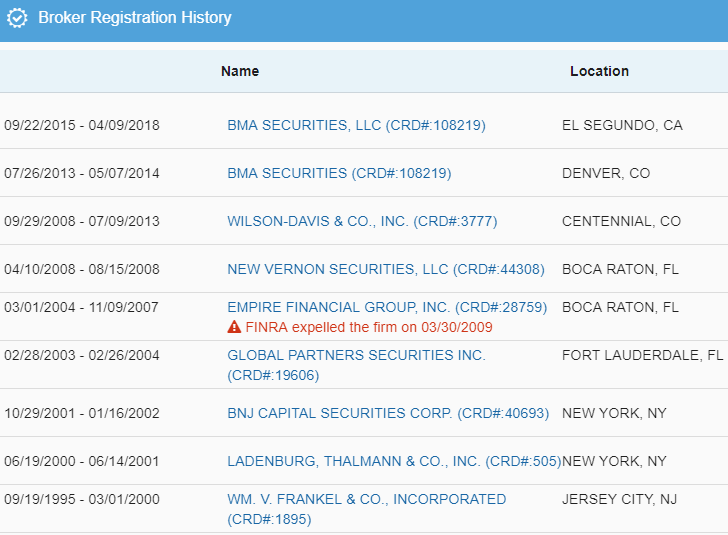
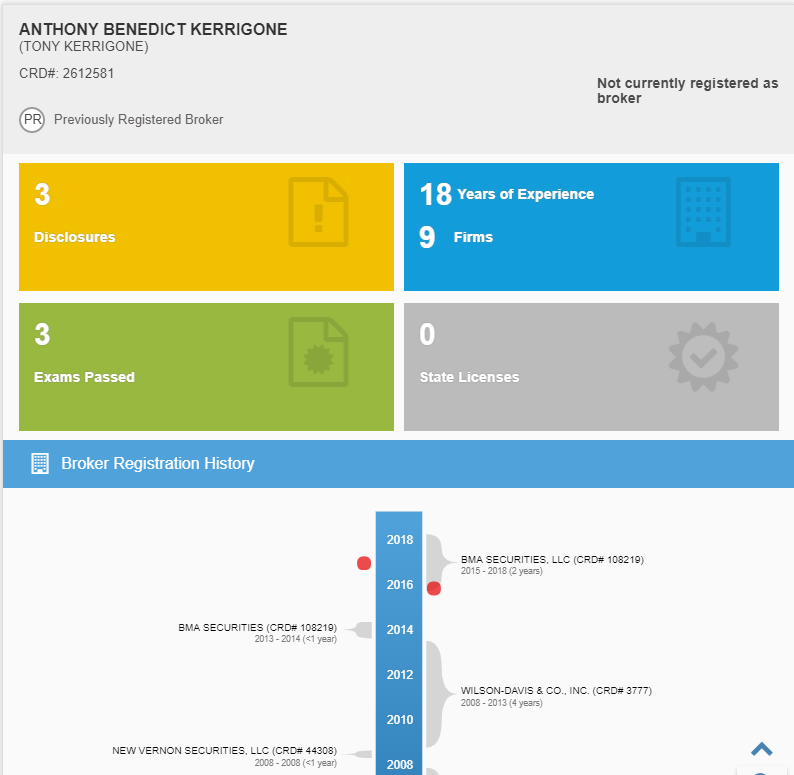
According to FINRA Brokercheck, Anthony Kerrigone is no longer employed by BMA Securities; his last day there was reportedly April 9, 2018. He is not currently registered as a broker.

Disclaimer. No position in any stock mentioned and I have no relationship with anyone mentioned in this post except that I am a subscriber to Promotion Stock Secrets and have been for a few years. This blog has a terms of use that is incorporated by reference into this post; you can find all my disclaimers and disclosures there as well.